

Welcome to the Comox Lake Watershed
No matter where you live on Earth, you are in a watershed. A watershed is an area of land where all the snow or rain that falls eventually travels to the same place. In the Comox Lake watershed that place is Comox Lake. Within the Comox Lake watershed are smaller sub basins named for the creeks and rivers that flow through them. This watershed is 461 square km in size and is the primary source of drinking water for residents of the Comox Valley.
-
The Comox Lake Watershed is located in the unceded territory of the K'ómoks First Nation and has been an important area for traditional and cultural activities since time immemorial. This interconnected system of forests, rivers, creeks, and wetlands links Vancouver Island mountains with the Salish Sea. This watershed sustains life in this territory and therefore its value is immeasurable. The Comox Lake watershed also provides drinking water for over 50,000 residents within the Comox Valley.
Image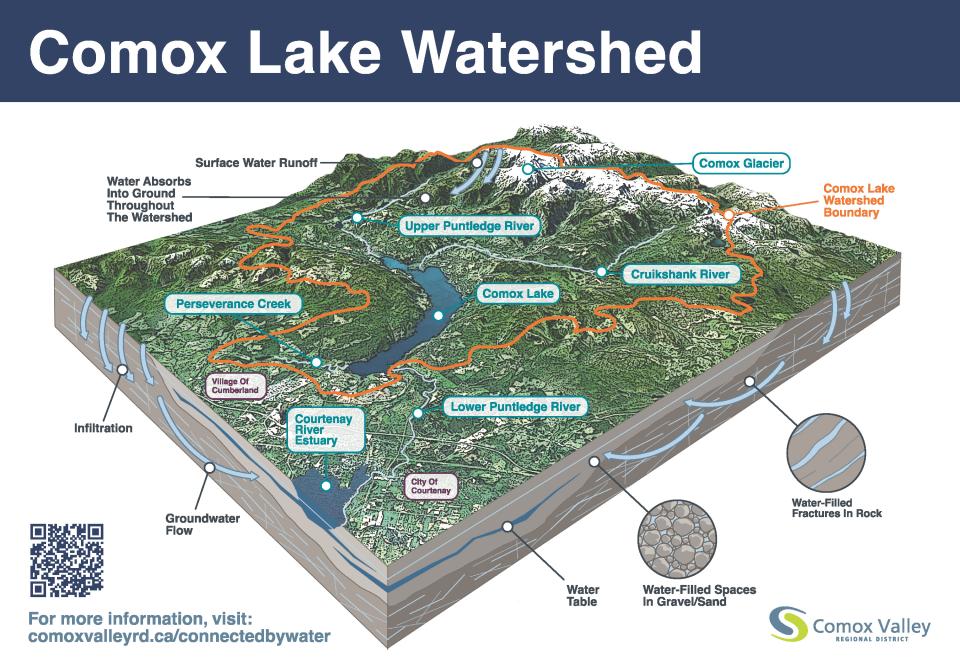
Connected by Water slice map outlining all areas of the Comox Valley Watershed For over 140 years, logging, mining, hydro generation, and recreation activities have taken place in the Comox Lake watershed, and many of these activities continue to have impacts. Although coal mining operations ended in the 1930’s, much of the watershed is still privately owned and managed for timber supply. The lake is also a reservoir controlled by BC Hydro for power generation and fish flows in the Puntledge River.
Swimming, boating, sporting events, training exercises, and camping still take place at limited sites along the eastern end of the lake, and all these activities can impact the health of our watershed. Demand for access to Comox Lake is only increasing as the local population grows and visitation increases. While small areas have been set aside for conservation, much of the watershed is still vulnerable to further impacts. Visitors can help reduce these impacts by staying on trails, using public toilets, camping only where permitted, and packing out everything they bring in.
Water is Life
The Comox Lake Watershed is located in the unceded territory of the K'omoks First Nation. This interconnected system of mountains, forests, rivers, creeks and wetlands links Vancouver Island mountains with the Salish Sea. This watershed sustains life in this territory and therefore its value is immeasurable. The Comox Lake watershed is also habitat for many species of animals, plants and trees that have been utilized by the Pentlatch and K'omoks people’s since time immemorial.
Human Impacts
For over 140 years, logging, mining, hydro generation and recreation activities have taken place in the Comox Lake watershed and these activities continue to impact the health of the watershed. Much of the watershed is still privately owned for timber supply and the lake is managed as a reservoir by BC Hydro. Some areas have also been set aside for conservation. Visitors to the watershed have an important role to play in helping to reduce further impacts.
Current Day
Although coal mining operations ended in the 1930’s, much of the watershed is still privately owned and managed for timber supply. As well, the lake is a reservoir controlled by BC Hydro for power generation and fish flows in the Puntledge River. Swimming, boating, sporting events, training exercises, and camping also take place at limited sites along the eastern end of the lake. All of these activities can impact the health of our watershed and the demand for access to Comox Lake is only increasing as the local population grows and visitation increases.
From Source to Tap
High quality drinking water is produced by healthy functioning ecosystems. To ensure the water reaching our taps is safe and reliable we need to protect the source. What people do on the land and in the water directly affects the health of the watershed and the quality and quantity of the freshwater within it. By acting responsibly we can help protect the Comox lake watershed for future generations.
Protecting our Watershed
Please stay on marked trails and do not camp or light fires anywhere outside of official campgrounds. Off road vehicles are not permitted anywhere in the watershed. Licensed vehicles are permitted on primary resource roads only when allowed by landowners. Be sure to use designated bathrooms and pick up dog waste to reduce pathogens entering our drinking water system. Avoid using skin products that wash off in the water, and never fuel up, empty or clean boats, bilges or recreation vehicles in or around Comox Lake.
-
Every summer, residents and visitors head to local lakes and rivers to cool off, recharge, and enjoy the outdoors. Sunscreen is an essential part of these days, helping protect our skin from harmful UV rays.
But what we put on our skin doesn’t always stay there.
As we swim and play, sunscreen washes off into the water—entering lakes and rivers where it affects the delicate balance of aquatic life, from insects and plants to fish species that depend on them. Over time, this can impact the overall health of the watershed.
Healthy ecosystems are the foundation of high-quality drinking water. This “source to tap” approach guides local watershed protection efforts, supporting more than 50,000 Comox Valley residents who rely on Comox Lake for safe, reliable drinking water.
Some common chemical UV filters, such as oxybenzone, octinoxate, and octocrylene, act as pollutants in freshwater environments. Research shows these substances affect the growth, reproduction, and survival of small aquatic organisms that form a critical part of the food chain.
These organisms make up a significant portion of the diets of species like resident rainbow and cutthroat trout, as well as juvenile salmon. Impacts at this level of the food web cascade upward, impacting fish health and population dynamics and other aquatic and riparian species.
When you put a chemical sunscreen on your skin and head for local lakes and rivers, the impacts ripple throughout the entire ecosystem.
Local organizations, including the Courtenay Fish and Game Protective Association, Lake Park Society, and regional race organizers are helping raise awareness about the connection between sunscreen use and watershed health.
Protecting our watershed is a shared responsibility. While the challenges are complex, choosing how we protect ourselves from the sun is a simple, meaningful step.
Next time you head out, take a moment to check your sunscreen. Opting for mineral-based, freshwater-safe options that use zinc oxide or titanium dioxide (non-nano forms) can help reduce your impact on aquatic life and support the long-term health of our watershed.
A small change can make a real difference.
What can you do?
- Choose mineral-based sunscreen which is less harmful to aquatic organisms
- Apply sunscreen before arriving at the water to allow it to absorb fully.
- Avoid spray-on formulas near streams, docks, or shorelines.
- Cover up naturally with UV-protective clothing and hats.
- Be an ambassador for responsible sunscreen use.
Find out More:
Lake Cowichan, British Columbia (Canada) is moving toward banning local sales of sunscreens containing compounds considered harmful to salmon and the Cowichan River’s fragile ecosystem, part of a Canadian Heritage River system. Read more here.
Many lake and river parks now actively promote “reef- and river-safe” sunscreen and clothing, warning that certain sunscreen ingredients can damage freshwater ecosystems such as beloved swimming lakes and rivers. Read more here.
As the weather gets warmer and Canadians slather on sunscreen to enjoy the heat, some environmental scientists are worried about how our sun protection could be harming aquatic life once it leaves our skin. With millions of people around the world using sunscreen, the small amount that's washed off starts to add up. Read more here.
-
The management of the Comox Lake watershed is made more complex by the multiple land owners and managers in the watershed boundaries. These landowners work together to support the goals and objectives of the Watershed Protection Plan.
- BC Hydro - BC Hydro Recreation Area & Trails
- BC Parks - Strathcona Provincial Park and Comox Lake Bluffs Ecological Reserve
- Conservation Plan for Lands at Comox Lake and Perseverance Creek
- Comox Lake Land Corporation - cabin owners at east end of lake
- Comox Valley Regional District - Coal Beach and Whytes Bay lands
- Courtenay and District Fish and Game Society Protective Association
- Village of Cumberland - Cumberland Trail Network, Perseverance Creek Sub-Basin, Cumberland Lake Park
- Manulife Investment Management Resource Group (formerly Hancock)
- MOSAIC Forest Management
- Cumberland Community Forest Society
-
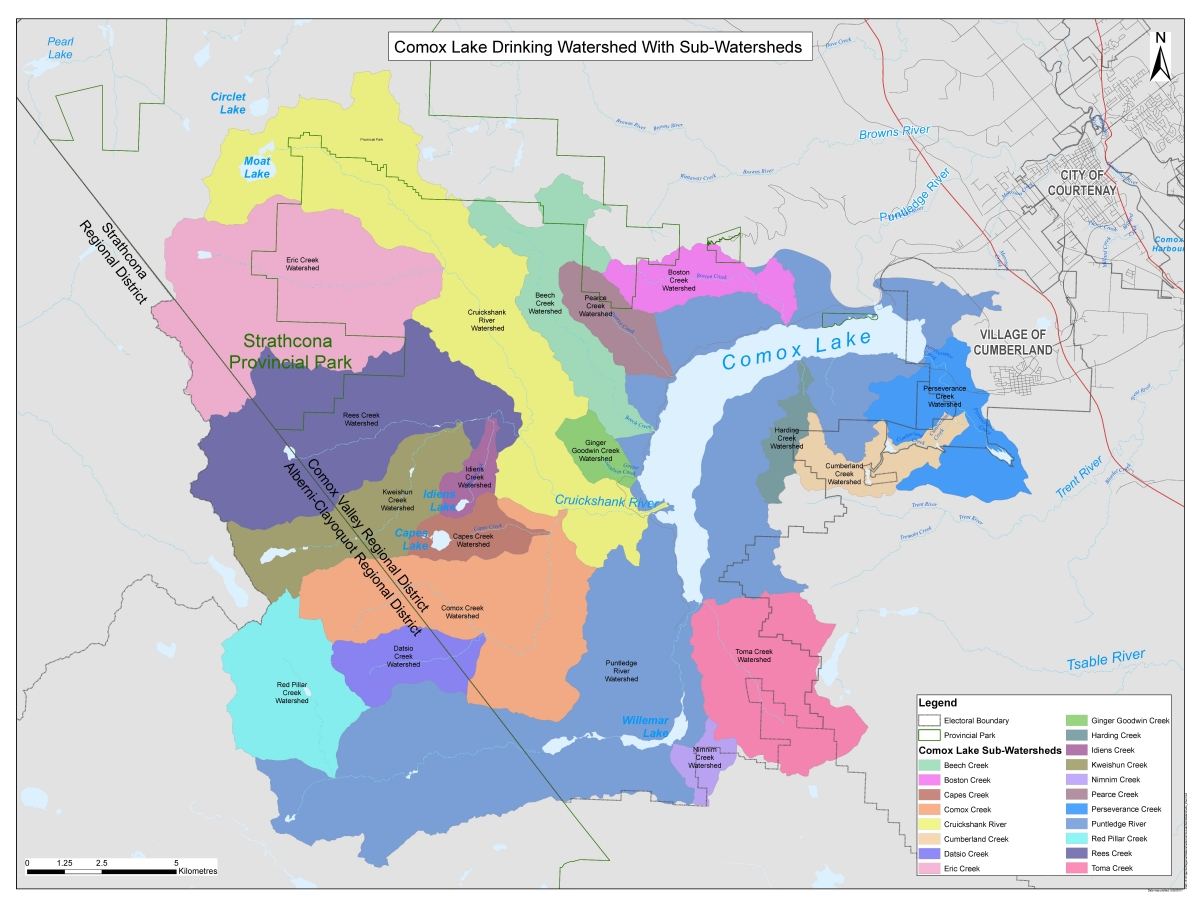
Within this watershed, there are smaller watersheds called 'sub basins' named for the creeks and rivers that flow through them, including the Upper Puntledge, Cruikshank, Boston Creek and the Perseverance Creek / Cumberland Creek sub-basins.
Click image to enlarge
-
In 2016 the CVRD published the first Comox Lake Watershed Protection Plan (WPP). This plan was the culmination of a multi-year process involving land owners, knowledge holders and stakeholders. This plan was updated again in 2022. The objective of the WPP is to guide the management of the watershed for the long-term protection of drinking water at the highest possible quality.
This plan takes a source-to-tap approach to the protection of drinking water resources. This approach acknowledges that source protection of the water supply area, and the treatment and distribution of drinking water to the community, must be understood and managed as a whole.
-
- Report all fires (911) outside of designated 2 campgrounds.
- Access and recreate only in designated areas.
- No off road motorized vehicles (OHVs).
- Protect forest and creekside vegetation.
- Use dedicated washroom facilities.
- Do not wash boats or rinse bilge.
- Avoid use of body care products and sunscreen when swimming.
-
Connected by Water
Connected by Water is a CVRD program developed in response to the community education and engagement recommendations in the Comox Lake Watershed Protection Plan. The goal of this program is to build capacity, community and connection to support watershed protection and water conservation efforts.
Working with community stakeholders and knowledge holders, the Connected by Water team has developed curriculum resources, workshops, projects, tours, presentations and a framework for discussion and learning.
-
Public access is only regularly permitted at specific locations on lands in the Comox Lake Watershed, but only for low impact, non-motorized use. This is unique from many drinking watersheds in the province that do not allow any public access. These low impact public access points are the BC Hydro Recreation Area, BC Parks Comox Lake Bluffs Ecological Reserve, Lake Park Campground, Strathcona Provincial Park and the Conservation Lands at Lower Perseverance Creek and Comox Lake.
Private landowners including the Courtenay and District Fish and Game Protective Association, Manulife Investment Management and Mosaic Forest Management permit access through membership, access permits, or select open gate days.
With this access comes responsibilities to ensure the protection of this critical community resource. There are several activities that are not permitted anywhere in the watershed.
Campfires, beach fires, and camping, are NOT ALLOWED in the Comox Lake Watershed.
*Exceptions are at official campgrounds (Lake Park and Courtenay Fish & Game) in accordance with campground rules, or with a Village of Cumberland fire permit at the Comox Lake Land Corporation cabins and other private homes within the watershed.
Recreational ATVs, dirt bikes and unlicensed off-road vehicles, are NOT ALLOWED ANYWHERE (on-road or off-road) in the Comox Lake watershed. *Licensed vehicles may be permitted on primary resource roads only when allowed by private landowners.
Please stay on marked trails, do not create new trails and do not trample vegetation. Be sure to use designated bathrooms and pick up dog waste to reduce pathogens entering our drinking water system. Avoid using skin products that wash off in the water, and never fuel up, empty or clean boats, bilges or recreation vehicles in or around Comox Lake.
*The Comox Valley Regional District recognizes and affirms the continued exercise of constitutionally protected Indigenous rights in the watershed such as: hunting, fishing, gathering, social, and ceremonial activities.
-
More information: Conservation Lands at Comox Lake and Perseverance Creek
