
Courtenay, BC - Emergency harvest bans for bivalve shellfish (ex. clams and oysters) put in place following a sewage leak on May 26 have now been fully lifted after testing on water and shellfish in the area show results within acceptable levels.
The emergency closure was put into place for subareas 14-9, 14-10, 14-11, 14-14 and 14-15 as a precautionary measure while Environment Canada and the Canadian Food Inspection Agency completed testing in the area. On June 5, the closure was revoked for 14-14, and on June 8 it was revoked for the remaining areas after all sample results met standards outlined in the Canadian Shellfish Sanitation Program.
To view the fishery notice, click here. Please note that this does not describe other sanitary closures that may be in effect unconnected to the sewage leak.
“This is another piece of good news as we continue to monitor and measure the impacts of this critical incident.” said Charlie Gore, Senior Manager of Capital Project Delivery. “While we continue to assess the immediate spill area, we’re glad that in the harbour and beyond, people can return to their normal uses.”
The CVRD also shared that - following reports of toilet paper found on area beaches - environmental consultants completed an investigation and confirmed that it was dried, bleached seaweed (Ulva – or sea lettuce) and is unrelated to the sewage leak.
Testing completed since a sewage leak on May 26 has generally returned good water quality results and the CVRD lifted a water advisory for the Comox Harbour and Estuary, outside of the immediate spill area, on June 3.
The advisory remains in place for the foreshore between Jane Place and the Comox Wharf as well as the water within the Comox Harbour Authority east marina (see map below) – people should not interact with the foreshore or water in that area until further notice.
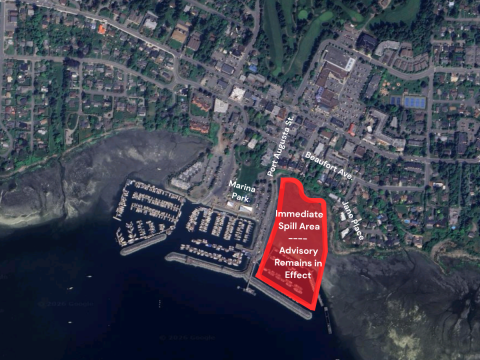
To follow along for updates, visit www.comoxvalleyrd.ca/sewageleak
The Comox Valley Regional District is a partnership of three electoral areas and three municipalities operating on the unceded traditional territory of the K’ómoks First Nation, the traditional keepers of the land. The members of the regional district work collaboratively on providing sustainable services for the benefit of the diverse urban and rural areas of the Comox Valley.
-30 -